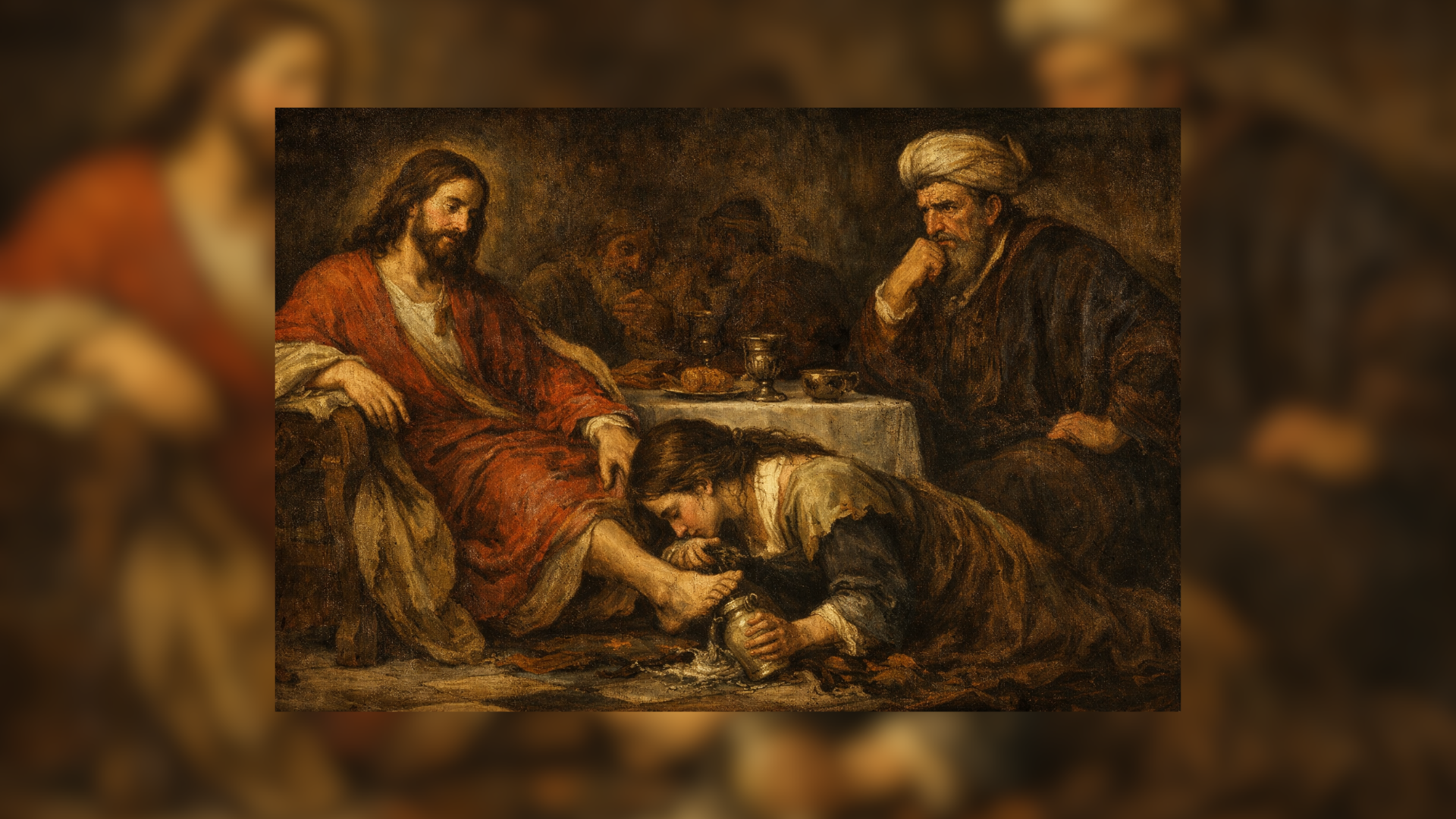


In the first part of my meditation on Matthew 7:1-5, I sought to reflect on Jesus’ way of speaking hard truths, noting how His disciples responded with deeper love rather than resentment. I wanted to emphasize that citizens of heaven aren’t called to live as judges but as family—that Jesus’ words in Matthew 7:1-2 speak more to condemning others than to abandoning discernment.1
Knowing that the Greek word krino, which Matthew uses in the text, carries a judicial sense of condemnation, we then apply this to church life to see how subtle attitudes and cold looks can make people feel excluded or condemned for their appearance, background, or behavior, leading to a cycle of mutual judgment. In the Sermon on the Mount, it’s the one who condemns who is singled out, not the one who knows they’re in sin. The one who has fallen should seek the Lord’s forgiveness, but sometimes the judgmental attitude of condemnation blinds us, to our own detriment. Thankfully, the Bible is rich and multilayered, so we can see this principle played out when an unexpected, uninvited guest shows up to dinner and we see how Jesus practices what He preaches in Luke 7:36-50.2
The judgment with which we judge follows the natural order of reciprocity. In Luke 7, we can peel back the layers to see mutual judgment enacted. It’s not just horizontal, between two people who don’t like each other. Oddly enough, we sometimes see this as a problem only this way, but it goes deeper. To gloss over the vertical aspect (between God and us) would rob us of the full impact of Jesus’ wisdom. In Luke, we’ll see how God is involved, too.
The story is set as Jesus is invited to dine at Simon’s house. We learn in verse 37 that Simon is a Pharisee. The Pharisees were a strict sect in first-century Judaism who prided themselves on their deep reverence for and knowledge of the scriptures, and on a life entirely devoted to following them. Some experts affirm that they were the religious current at the time with which Jesus held the most in common. But they were also known for stringent legalism, and it appears that Simon is no different. This is interesting to us because, although in our main text, the Sermon on the Mount (Matthew 7:1-5), Jesus is speaking to everyday people, in Luke, we can put flesh on the principles as Jesus interacts with one of the religious elite.
As they are eating, suddenly they are interrupted by a woman who appears to barge in uninvited. In verse 37, the details get juicier as we read: “And behold, a woman of the city, who was a sinner, when she learned that he was reclining at table in the Pharisee’s house, brought an alabaster flask of ointment.” As Jesus is relaxing (reclining) at Simon’s table, certainly enjoying scintillating conversation about the finer points of the law, this woman pushes past everyone. She’s described as a sinner. We don’t know her name, only her reputation, and it’s not a good one. For her only identifying mark, to be a sinner, and to be carrying an expensive perfume, speaks of more than a known liar or drunkard. The nuance is an adulteress or possibly a prostitute. My first question is, why is she at Simon’s house? How does she know so much about what happens there, and can so easily get into his living room? But I ask these questions because I can be quite judgmental too!
Then the scene gets a lot more awkward as she throws herself at Jesus’ feet, who is still reclining, probably lying down on a divan or a few cushions, as it was customary. Without any warning, she begins crying over His feet so much that she actually wipes them with her hair. If there were any question in the minds of Simon and the other guests that she was a “sinner,” this would have been it. Righteous women never let their hair down in public, and especially didn’t throw themselves at the feet of some Rabbi. At this point, it would have been difficult to continue eating as if nothing were happening; the woman’s sobs, her actions, would have silenced the room. What was Jesus doing? Didn’t He read the social cues? How can He sit there and let her degrade himself and dishonour Simon’s house with this behavior? Verse 39 says it all. “Now when the Pharisee who had invited him saw this, he said to himself, ‘If this man were a prophet, he would have known who and what sort of woman this is who is touching him, for she is a sinner.”
Now Jesus knows this. Let’s not forget that in His humanity, He sits at the table of a prominent man, and in His divinity, Jesus knows what’s in Simon’s heart. The mystery of the Lord is boundless because we see, in real time, the two natures of Christ at work, opening our eyes to the depth of what’s happening and inspiring pure amazement. Jesus tells Simon a story in the hearing of everyone whose jaws are wide open in social shock.
“A certain moneylender had two debtors (v41), one owed him 10,000€ and another 100,000€ (my addition). The economy took a bad turn, investments turned up empty, and inflation swallowed them whole. Neither could pay. Both begged for debt forgiveness. As this money lender wasn’t a loan shark but a good man who wanted to help people, he forgave them. Both. So, Simon, which of the two do you think loved the man more?”
Now Simon, like all of us, answered correctly (v42-43). And Simon, who so quickly judged the Lord, was about to have his heart revealed and handed to him. Luke 7:44-47 says it best.
“Then, turning toward the woman, he said to Simon, “Do you see this woman? I entered your house; you gave me no water for my feet, but she has wet my feet with her tears and wiped them with her hair. You gave me no kiss, but from the time I came in, she has not ceased to kiss my feet. You did not anoint my head with oil, but she has anointed my feet with ointment. Therefore, I tell you, her sins, which are many, are forgiven—for she loved much. But he who is forgiven little, loves little.”
Simon thought he understood. It was so obvious! Who couldn’t see that this woman, a sinner, was acting completely inappropriately? If Jesus were truly a prophet…unjust judgment…how could she possibly do…condemnation… If we judge to condemn, we attract condemnation. Jesus doesn’t condemn her; He doesn’t even condemn Simon (although it could be argued I just did), but in righteous, loving, divine knowledge, He shows us the whole picture. He even shows us how futile our judgments are. What would that say to the religious elite who made their place in the world by such distinctions? What would that say to the Romans who saw themselves as superior by birth, the world leaders of the time? What does it tell us? Do we condemn too? The unexpected, uninvited guest that really upset the evening wasn’t the poor lady at the feet of Jesus, it was the condemning heart.
Indeed, there must be a better way. As I shared last time, the way beyond condemnation begins at the cross. This is where our sin was judged and forgiveness purchased. The beauty of Jesus shows us the futility of condemning, and by His Spirit, we can transition from the position of Simon to the better place of the woman who came to worship.
Once we find ourselves there, in a place of prayer rather than condemning, we could intercede for the person, ask the Lord to help us see our motives and understand what is really bothering us. If a conversation with the person is necessary, maybe a few questions might be the way to start. I’m not sure I understood, what did you intend when you said… how do you feel about… can we talk about…? Perhaps if we understand their perspective, our conversation may prove to be richer. The most difficult part in this process is getting our heart in the right place before we engage.
Remembering the cross frees us from judgmental attitudes and calls us to a better way of love that reflects Jesus’ heart toward others. This love is a work of the Spirit in us; it’s not a “try harder,” “don’t be another judgy Simon” kind of message we hear across the dividing lines of most polarizing issues. What I’m advocating for is the kind of transformation that makes condemnation irrelevant (that will be more of the subject of the next piece). The more I look into the beauty and majesty of grace, the more I understand how little a moralistic exhortation can help. We need the Spirit’s power rushing through us and pouring out Christ’s love in our hearts. Then we can show that uninvited intruder, the condemning heart, to the door.
References
[1] Discernment is clearly taught in the verses that follow my passage, and there’s much that could be said about it, but I want to remain on topic for this series of blog posts. Also, I’m of the firm conviction that the order of the Lord’s words are important. I don’t know if we can truly discern until we’ve looked at this issue.
[2] I owe much of what I’ve learned about Wisdom literature and the Lord’s way of teaching to Zack Eswine, as in his book Wiser with Jesus.